

Het Atelier
Built in 1936 as an artist’s studio, Het Atelier lies by the sea and the 300-hectare forest. Full of “Zeeland light” and quiet charm, it blends history and warmth in a timeless setting.
With cosy corners and a tranquil terrace, this characterful home invites you to slow down and enjoy the simple beauty of Zeeland life.


About The Space
Het Atelier was built in 1936 as an artist’s studio at the bottom of the garden, in the expressive Amsterdam School style. Today, it’s a characterful holiday home with three bedrooms: one double (180 × 200 cm) and two single beds (80 × 190 cm). Guests have sole use of the house, a quiet private terrace at the back, and access through a shared front garden path. Inside, you’ll find a living room with cable TV, a dining room that opens onto the terrace, a cosy study with an open hearth, and a fully equipped kitchen.From the house it’s just a 6-minute walk (550 m) to the Blue Flag beach, the dunes, or the beautiful 346-hectare forest. Highlights: • Private back terrace • Fully equipped and stocked kitchen • Safe neighbourhood • 3 km to the centre of Burgh-Haamstede
Guest Access
Guests have full, private access to the house and private back terrace. Please note: The staircase is quite steep (typically Dutch!). The toilet is on the ground floor, and the shower is on the landing.
A Brief History
Het Atelier was built in 1936 at the tail end of the crisis years, designed by my uncle, architect Ir. F.C.J. Dingemans. He trained under Willem Dudok — known for the Hilversum Town Hall (1928–1931), where Dudok designed not only the building but also its furniture, lighting, and fixtures. Frans carried that same belief in total design into his own early work, where architecture, furnishings, and landscaping were conceived as a cohesive whole.
This is especially visible at Het Atelier, which he furnished with pieces designed specifically for the space and surrounded with outdoor features such as a pond and pergola. Built during a time of economic hardship, the project gave valuable work to local craftsmen, and many of its original elements remain intact today.The house was later considered a model for Schouwenburgh in Burgh — now a Rijksmonument (ID: 496669). Both houses share key features: a tower, a study with a barrel-vaulted ceiling, and large French doors opening from the dining room to the terrace.
Het Atelier remains almost entirely in its original condition: warm, traditional, and intimate — a house that reflects both its time and its maker.
This is no resort property — it’s a lived-in, much-loved house full of warmth and history. One guest put it perfectly:
“Unique small house with lots of room. So many different spaces with their own style! Of course you have to enjoy an older house…”
About the Architect

Frans C.J. Dingemans (1905–1961) was a Dutch architect and urban planner trained at TU Delft. Early in his career, he worked under both Brinkman & Van der Vlugt (1927 to 1929) and Willem Dudok (1929 to 1934), where he was exposed to two key strands of Dutch modern architecture: Dudok’s expressive and integrated approach to design, and the radical functionalism of Brinkman & Van der Vlugt, best known for their pioneering work in the Nieuwe Bouwen movement, including the iconic Van Nelle Factory in Rotterdam.
In 1942, Frans Dingemans was appointed director of urban development in Maastricht. When the role was later restructured, he focused fully on design as municipal architect, while also running his own architectural practice. Until his sudden death in 1961, Dingemans played a leading role in shaping post-war Maastricht.
His early work, including Het Atelier, reflects Dudok’s influence in its brick detailing and cohesive interior design. Later projects, most notably the Gemeenteflat on the Koningsplein (Rijksmonument 530717), show a clear shift toward Nieuwe Bouwen, with an emphasis on light, clarity, and functionality in urban housing approach.
His portfolio includes the redevelopment of the Stokstraat quarter in Maastricht, several post-war residential districts, and the Post Office on Boulevard 1945 in Enschede, a classic modernist structure that has recently been repurposed as a Vue cinema complex. The parish districts in the west of Maastricht are particularly noted for their careful integration into the surrounding landscape — a hallmark of his thoughtful planning approach

Sand between your toes, and sun on your face, a 5-minute stroll away

Start your mornings with coffee and croissants overlooking the terrace
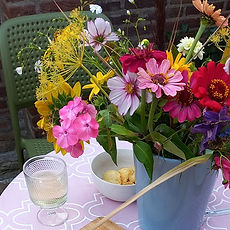
Unwind a the end of another relaxing day on your private terrace.
-001.jpg)
A scenic route stroll offers a perfect blend of nature's charm.


Where You'll Sleep

3 bedrooms
1 King bed / 2 single beds


.png)


Cancellation policy
Cancel up to 14 days.
More Info >
Note: Due to the open staircase, we advise caution with toddlers or crawling babies. A travel cot and high chair are available. Families with babies in arms have stayed comfortably, but please consider whether the layout is right for your needs.
Rental registration number: 1676 5AA7 5EA4 EB87 17DC


